Anthony Timberlands Center for Design and Materials Innovation at the University of Arkansas, Fayetteville, AR / 2025
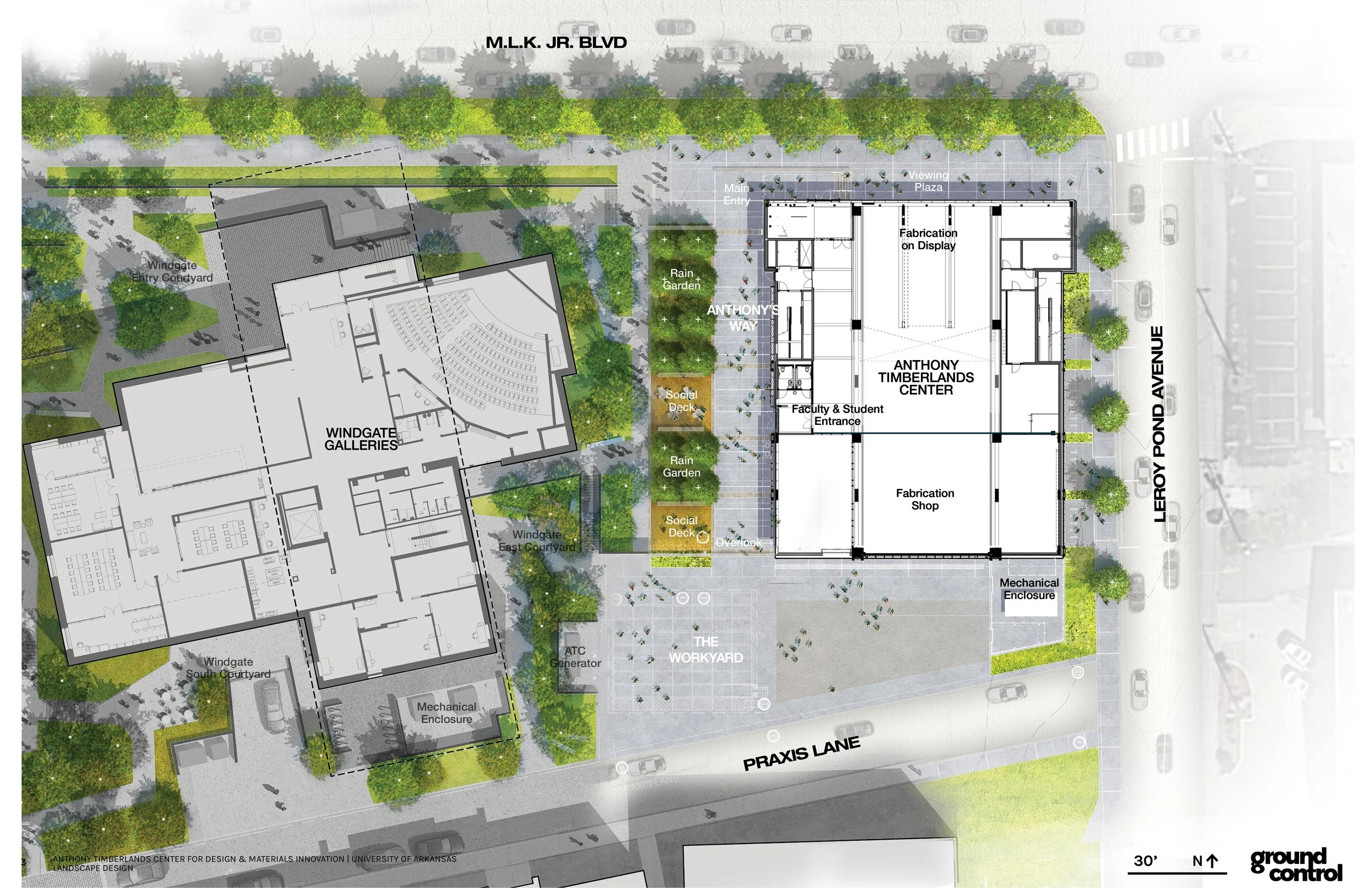
The Anthony Timberlands Center’s landscape functions as a living classroom—an immersive environment that engages students, faculty, and visitors in Arkansas’s material and ecological systems. Two primary outdoor spaces—the Work Yard and Anthony’s Way—anchor the project, each designed as an extension of the building’s craft, construction, and pedagogy. Framing these spaces, the MLK Boulevard and Leroy Pond Avenue streetscapes elevate the public realm, improving pedestrian safety and establishing a shaded, walkable district.
Anthony’s Way
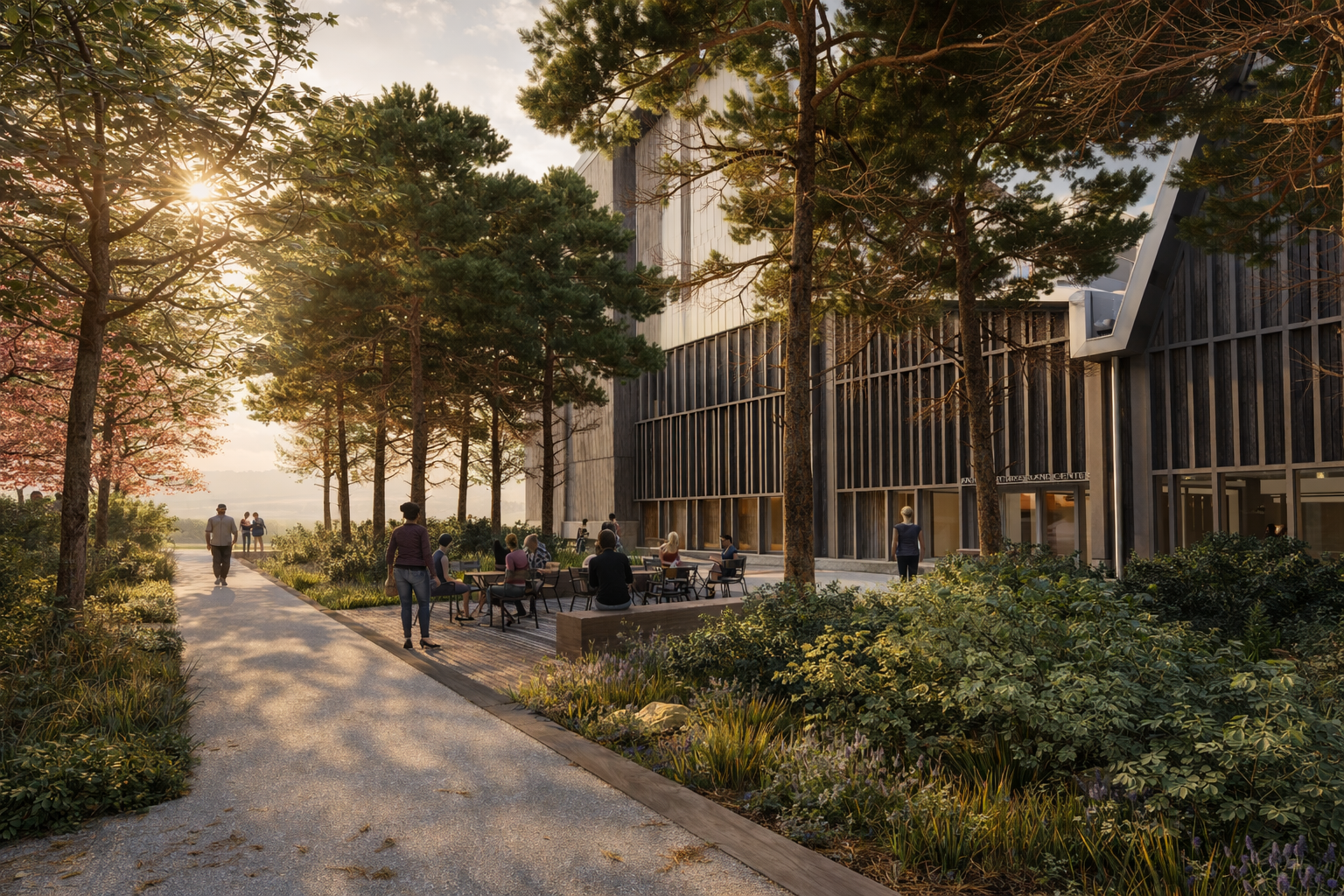
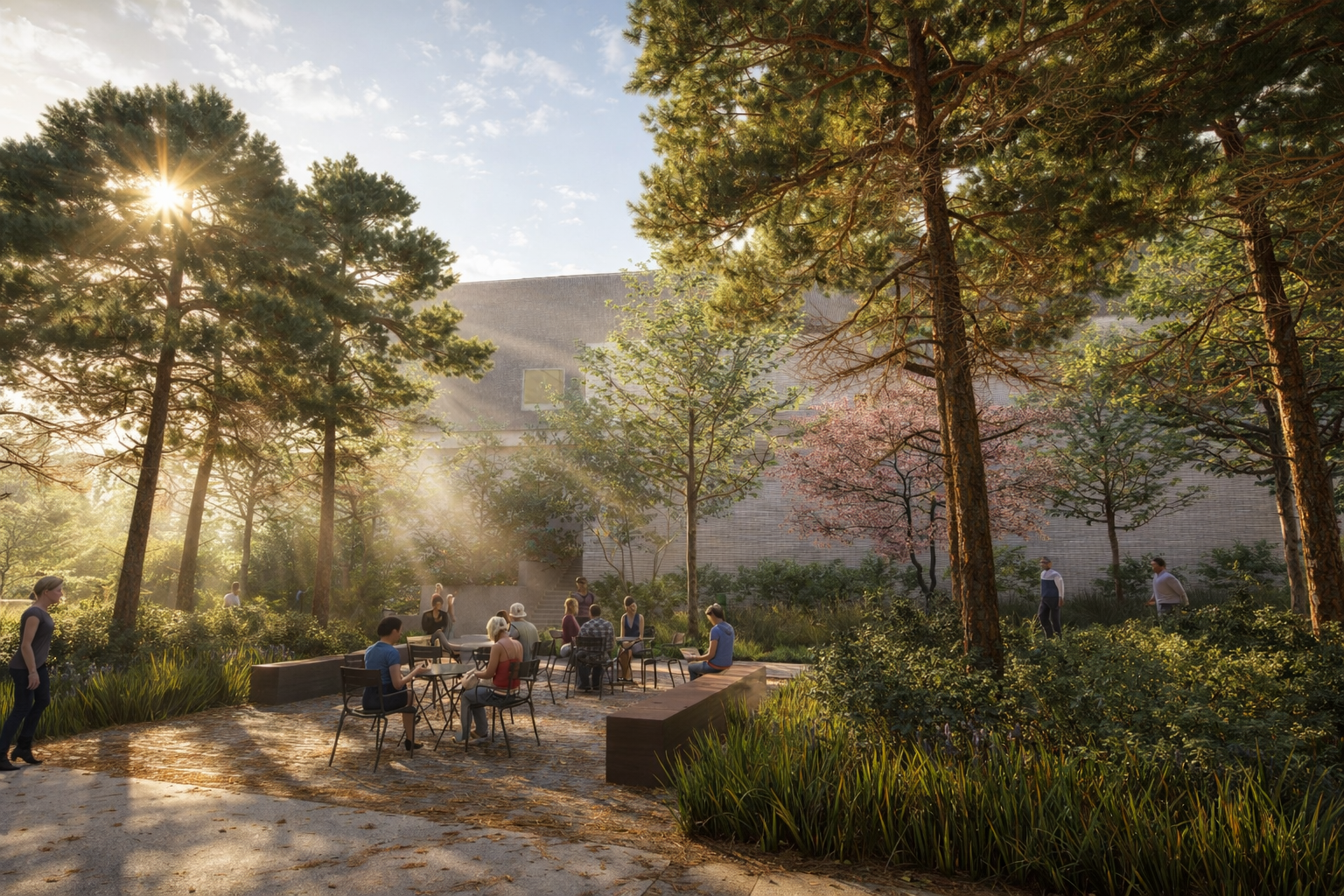
Anthony’s Way unfolds as a living corridor—a processional landscape that draws its character from the Ouachita National Forest, where pine and hardwood weave across uplands and valleys in a rhythm of canopy, understory, and filtered light. This outdoor room is both civic and ecological: a place of gathering, teaching, and repose that translates the forest’s layered structure into a contemporary campus landscape.
A rain garden, wrapped in hand-laid Arkansas Sandstone, captures roof water and site runoff, transforming rainfall into a visible, seasonal spectacle. Runoff moves through sandstone troughs—carved and set with the precision of joinery—where water becomes sound and movement. This choreography of flow echoes the region’s creeks and falls, connecting the life of the building to the hydrology of its place.
Spanning the rain garden are a series of Social Decks constructed of Black Locust, a naturally rot-resistant hardwood native to the Ozark and Ouachita foothills. These decks serve as outdoor extensions of the interior studios—places for pin-ups, conversation, and pause—while allowing rainwater to infiltrate freely beneath.
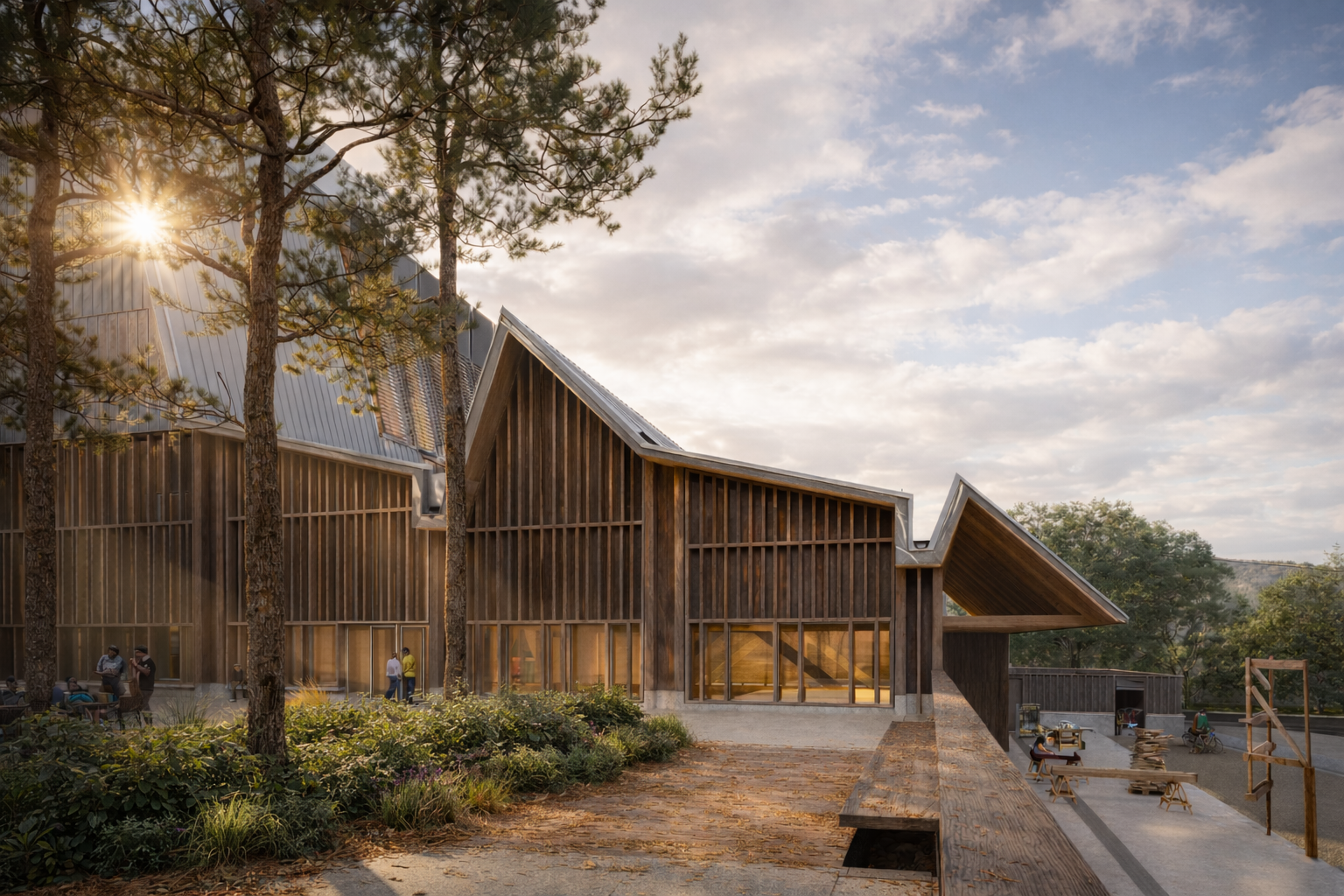
At the heart of Anthony’s Way are the custom timber benches, each a small monument to the legacy of Arkansas’s forestry and craft industries. Fabricated from black locust, the benches are designed as both furniture and artifact—objects that invite touch, trace the grain of local species, and tell stories of working forests and skilled hands. Their joinery recalls vernacular construction methods, crafted in collaboration with local woodworkers.
Above, an ordered bosque of Shortleaf Pine—the state tree of Arkansas—casts dappled shade over this linear grove. The pines, arranged in a tight rhythm, evoke the silvicultural grids of managed forests, while the ground plane beneath shifts with an understory tapestry of native shrubs and grasses. Together, they create a living gradient of texture and light, echoing the Ouachitas’ seasonal changes: the burnished gold of fall, the silver-green of winter, and the soft resurgence of spring.
At its southern edge, the Overlook anchors the experience—a crafted threshold where stormwater emerges again through a sculpted weir, descending to the Work Yard below. The gesture recalls the small cataracts and sandstone shelves of the Ouachita rivers, where water and stone perform a quiet dialogue between permanence and passage. Anthony’s Way is thus both a landscape and a lesson—a place that teaches through immersion, material honesty, and the enduring story of Arkansas timber.
The Work Yard
Below, the Work Yard operates as an open-air studio—equal parts fabrication court, delivery zone, and gathering space. Its durable surface of cast-in-place concrete and local gravel grounds the activity of making, while native plantings cascade down from Anthony’s Way, softening the threshold between landscape and architecture. A concealed subsurface vault manages stormwater, slowing runoff and extending the site’s capacity for performance and resilience.
Design Architect Grafton Architects
Architect of Record Modus Studio